I've actually been postponing writing a Santiago post. In just three short days, I walked so much and fell in love with Santiago that I am worried this post may end up overwhelmingly long!
I had been told that Santiago is a great city for living but not really for visiting. I had a great time visiting and I could see that it's a very live-able city. It has a strong arts scene in every sense. Runners exercised throughout the day. The architecture is varied, but there are neighborhoods that are modern, European, and plenty that are distinctly Chilean. This year saw the hottest March in one hundred years and the heat was still evident when I visited. Locals were out at every hour, whether they were on their way to work, making out in a park, or meeting friends for drinks.

The metro makes the city very manageable and easy to get around. And I have never seen so many people offer to give up their seat for the elderly, the pregnant, anyone with a young child, and women in general! I think I only stood once or twice on the train all weekend, and even then it was when the train was completely packed and inevitably a man would tap me on the shoulder to offer me a newly vacated seat.
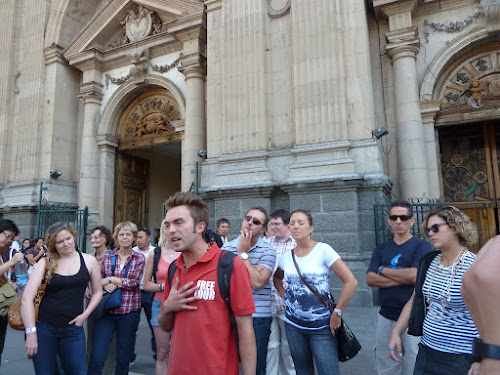
After having wandered around the city on my own, I did a fantastic walking tour of the city on my last afternoon. In hindsight, I wish I had done it on my first day! The tour brought me to a few places I hadn't seen before and I had a better appreciation of the city and its history afterwards. Also, our guide was one of the most naturally animated people I've ever met!
First stop of the tour was Plaza de Armas. Every major city in Latin America has a Plaza de Armas. The first thing the Spaniards did upon establishing a new city was to build a central square to be used as a defensive base. The city of Santiago is naturally well defended: rivers bordered two sides of the city (la Cañada has since been diverted), and the mountains pretty much took care of the rest.
In colonial times, Plaza de Armas was home to the most senior Spanish officials. Today it houses museums, offices, and a beautiful post office. A statue of Santiago's founder is pictured below.
The Mapuche were already living here when the Spaniards arrived. The two sides clashed many times, the Mapuche even burning down the cathedral at one point. The cathedral has been rebuilt several times over the past few hundred years as a result of attacks and earthquake damages. As it stands today, la Catedral Metropolitana is beautiful with an equal interior. Arches are used on the exterior and interior so as to reinforce the structure.
La Moneda, the coin, used to be a mint and is now home to the president's office. (Chile's president gets to select his or her residence; current president Sebastian Piñera lives in the mountains where the city's wealthier residents live.) The stations of the cross had been erected in front of la Moneda in anticipation of Easter.
The greenery around La Moneda is a pleasant space filled with friendly stray dogs and lined with statues of former presidents. Long before 2001, September 11 was an important date in Chilean history. On this date in 1973, the Chilean air force attacked La Moneda and President Salvador Allende, the world's first democratically elected Socialist president, died.
Allende's death remained controversial for decades. He was shot with a Kalashnikov but some claimed he committed suicide, which would be challenging with such a large weapon, while others maintained he was killed as members of the coup d'état entered his office. Allende's body was recently exhumed and scientists determined based on the angle of the wounds that he did, in fact, kill himself. General Augosto Pinochet took over on September 11, 1973 and began a dictatorship which would last until 1990.

Nearby is the former location of El Congreso. Forty percent of the country's population lives in the capital so, in an unsuccessful attempt to decentralize the government, the congress was moved two hours away in Valparaiso. Today this building houses government offices. When the building was built, the gardens were designed to be European. The landscape artist added the Chilean palm trees to give it a bit of a local feeling. Because the hearty Chilean palm is able to grow at altitudes of over one thousand meters, it is one of the few varieties of palm trees in the world that you can see with snow.
Across the street is El Corte Supremo. It was being renovated but it is a lovely, European style building.
The side of the Opera still displayed damage from the February, 2011 earthquake, though the front of the building has been repaired.
Cerro Santa Lucia is a hilly park with a great view of the city. It was a bit smoggy the day I climbed to the top so the mountains weren't clearly visible, but I was surprised to see how close they are to the city. The park used to be open twenty four hours a day but, in the words of my tour guide, "it's a very romantic place but maybe it got a little too romantic so now the park closes every night."
Barrio Lastarria is an artsy, bohemian neighborhood full of vintage clothes shops, cute cafes with chalkboards advertising specials in colorful script, and a Thursday-Sunday street market selling second hand books and antiques. One way or another, I found myself in this part of town every day.
In the evenings, Chileans all come to Parque Forestal to hang out. Between the park's design and all of the activities going on, it felt like a cross between Paris's Jardin Tuileries and New York City's Washington Square Park. Perhaps my favorite Chilean detail of the park is the presence of dog houses for the city's beloved stray dog population.
Across the street from the park is Emporio La Rosa, generally considered Santiago's best ice cream. I stumbled across it quite by accident: I saw a huge crowd of people and my human instinct to gather took over, so I went to investigate. When I realized it was a popular ice cream place, I joined the queue immediately. It was so busy, it took over twenty minutes from when I paid until I was served and it was well worth the wait.
The Museo de Bellas Artes is located on the edge of the park. Modeled after Paris's Petit Palais, buskers and performers in front of the museum draw crowds.
Fun fact for New Yorkers: you know those Nuts 4 Nuts carts that are on every corner selling honey roasted nuts? The business was started by Luis Martinez from Santiago. He began with one cart in Santiago and the business failed in no time. He managed to scrape together some additional funds, set up one cart in NYC, and the rest is history. Once the business had taken off in New York, he returned to Santiago where Nuts 4 Nuts has thrived ever since.
More common than Nuts 4 Nuts food carts are carts selling mote de huesillo, a popular Chilean drink. The sweet liquid is made from dried peaches and has a generous helping of cooked wheat on the bottom and a surprisingly large dried peach in the center.

I loved Santiago. I really didn't expect it to make much of an impression on me since these days I'd rather be in nature than in cities, but I found the city has plenty of parks and nature, plus great nightlife which I barely sampled but still enjoyed, a healthy arts scene, plenty of culture and museums, and, unlike Buenos Aires with its famous European atmosphere, Santiago still felt very much like Latin America to me. Its proximity to the mountains and the sea means you can easily enjoy the best of nature should you need to escape the city. It certainly didn't hurt that I was fortunate enough to stay with my good friend's hospitable mom in her cozy home (thanks again!). I could see myself happily living in Santiago one day. Of course, I'd first have to learn how to speak Chilean Spanish, which is no easy feat.