Encarnacion was always my planned destination in Paraguay (I ended up in Asuncion just because that was the closest airport). The town is best known as the gateway to nearby Jesuit ruins, about forty minutes outside of town.
Trinidad was established as a Jesuit mission on 1706. Father Juan de Anaya first settled here with just over six hundred families and the mission grew to more than three thousand inhabitants over time.
The church was built entirely of stone in typical European baroque style. The massive building was rich with ornate decorations that had held up relatively well over the last three hundred years. I especially loved the enormous bricks.
There were plenty of small statues and other relics to investigate.
The Jesuits were expelled from the region in 1768 and the indigenous population returned to their own traditional lifestyle. The buildings then fell into disrepair after years of neglect. Excavations began in the early 1970s and by 1993, the ruins were declared a UNESCO World Heritage site.
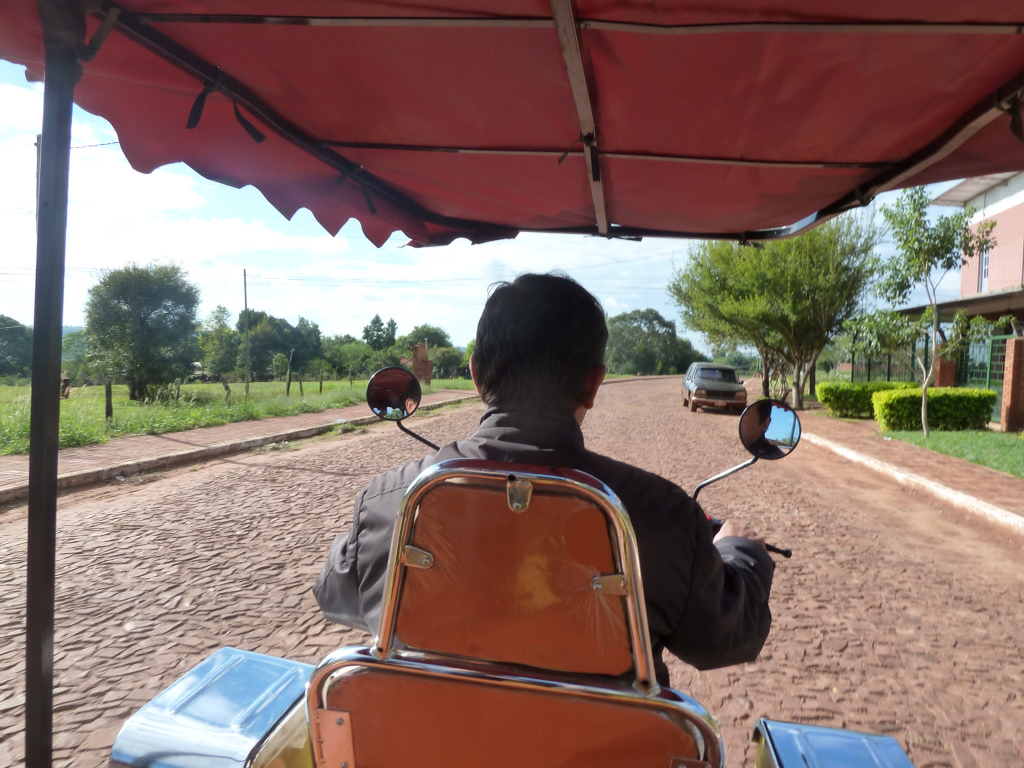
We took a mototaxi to see another set of ruins not too far away.
This was a smaller group of ruins, but no less impressive.
One of the great things about Paraguay is that there are so few tourists in the country, that you can have incredible historic sites like this pretty much all to yourself.
Friday, May 25, 2012
Wednesday, May 16, 2012
Asuncion, Paraguay
A couple of years ago, I thought about going to Paraguay for a week's vacation from school. A friend's sister had served there for Peace Corps, so I emailed him to ask her for tips. I have always found that PC volunteers have great pride in where they served and are always eager to share their country with other travelers. The response came back: have you thought about going to Brazil instead?
Not surprisingly, there's not really a whole lot to do in Asuncion and we didn't do any guided tours to learn more about the it's history, so this is kind of a short post.
A convenient way to carry your bread for sale.
The city's central plaza was undergoing renovations.
Some of the architecture was traditionally European in the day...
...and then Vegas neon at night.
We think this was the presidential residence. For sure, the guards will aggressively blow their whistles at you if they see you taking photos.
There was a lot of artistic and political graffiti throughout the city.
Asuncion was a city we could never figure out. How safe is it here? Where are the restaurants? Where are the people? Why are there so many little children out at 10pm on a Monday? Our favorite activity was watching the prostitutes and guessing man-or-woman. Or, as we called them, prosti-dudes. This is how I spent my time in Paraguay's capital.
Not surprisingly, there's not really a whole lot to do in Asuncion and we didn't do any guided tours to learn more about the it's history, so this is kind of a short post.
A convenient way to carry your bread for sale.
The city's central plaza was undergoing renovations.
Some of the architecture was traditionally European in the day...
...and then Vegas neon at night.
We think this was the presidential residence. For sure, the guards will aggressively blow their whistles at you if they see you taking photos.
There was a lot of artistic and political graffiti throughout the city.
Asuncion was a city we could never figure out. How safe is it here? Where are the restaurants? Where are the people? Why are there so many little children out at 10pm on a Monday? Our favorite activity was watching the prostitutes and guessing man-or-woman. Or, as we called them, prosti-dudes. This is how I spent my time in Paraguay's capital.
Tuesday, May 15, 2012
Montevideo, Uruguay
I spent a few hours sleeping in Santiago after arriving from Rapa Nui before returning to the airport on my way to Paraguay. Like with Lima, I had another 24 hour layover, this time in Montevideo, Uruguay.
It was a Sunday afternoon so the city was extremely quiet and most stores and museums were closed. I headed to the pier and saw lots of friends and families enjoying a lazy afternoon of fishing together.
I wandered through the old market, Mercado del Puerto, which is now filled with restaurants specializing in grilled meats.
Outside the market, vendors sell hats, notecards, and other artistic or handcrafted goods.
The old town was very European in its architecture. At night, the lit up buildings looked lovely.
It was a Sunday afternoon so the city was extremely quiet and most stores and museums were closed. I headed to the pier and saw lots of friends and families enjoying a lazy afternoon of fishing together.
I wandered through the old market, Mercado del Puerto, which is now filled with restaurants specializing in grilled meats.
Outside the market, vendors sell hats, notecards, and other artistic or handcrafted goods.
The old town was very European in its architecture. At night, the lit up buildings looked lovely.
Rapa Nui: day 5
Unfortunately, I had to catch a flight out of Rapa Nui and back to mainland Chile. I didn't do much in the morning before my flight, so I'll now share some tidbits about my time on the island.
The post office will stamp your passport with an Isla de Pascua stamp for free (mine is on the page next to my Antarctica penguin stamp!).
The island's only town, Hanga Roa, is so small that when two Swiss tourists at the airport realized they hadn't gotten their passports stamped and that the post office closed in fifteen minutes, there was enough time for one of them to sprint to the post office, get the stamps, and sprint back to the airport before the post office had even closed and in time to catch his flight out!
Either the fire department has a close relationship with Japan, or they really love the LA Lakers.
While Rapa Nui is worlds apart from mainland Chile, they are identical in one important aspect: countless stray dogs. Walking to sunset one night, we were followed for a good twenty plus minutes by a group of ten dogs!
The final step in completing a moai was to carve the eyes or the eye slots, as the white sclera are actually removable.
And here are a few parting moai shots...
Back to the mainland (be sure to get a window seat on your flight!).
The post office will stamp your passport with an Isla de Pascua stamp for free (mine is on the page next to my Antarctica penguin stamp!).
The island's only town, Hanga Roa, is so small that when two Swiss tourists at the airport realized they hadn't gotten their passports stamped and that the post office closed in fifteen minutes, there was enough time for one of them to sprint to the post office, get the stamps, and sprint back to the airport before the post office had even closed and in time to catch his flight out!
Either the fire department has a close relationship with Japan, or they really love the LA Lakers.
While Rapa Nui is worlds apart from mainland Chile, they are identical in one important aspect: countless stray dogs. Walking to sunset one night, we were followed for a good twenty plus minutes by a group of ten dogs!
The final step in completing a moai was to carve the eyes or the eye slots, as the white sclera are actually removable.
And here are a few parting moai shots...
Back to the mainland (be sure to get a window seat on your flight!).
Labels:
Chile,
outdoors,
South America,
unique landmarks geography
Subscribe to:
Posts (Atom)


